
Grades of Concrete: Complete Table, Uses and Applications
April 1, 2024
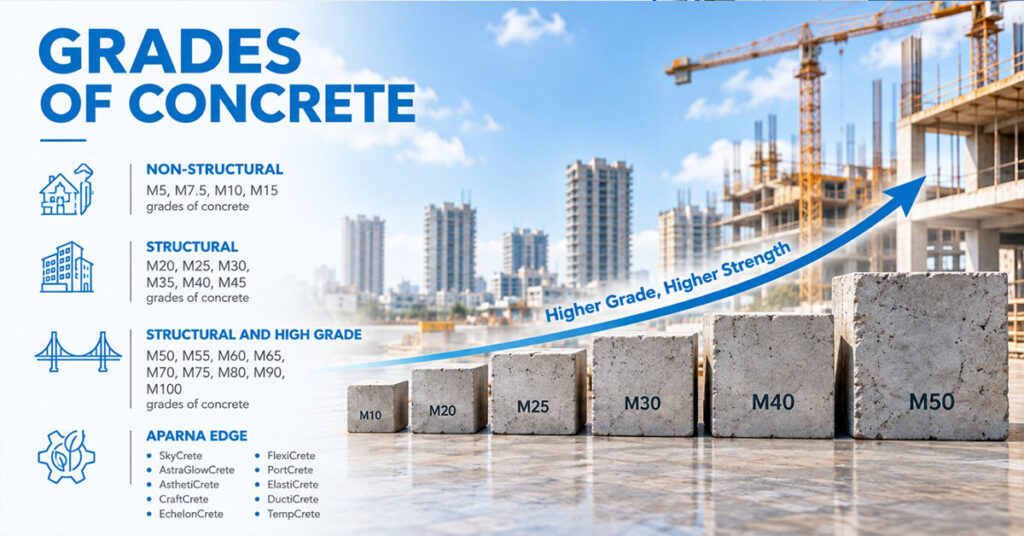
A grade of concrete tells you its specified compressive strength. In India, IS 456:2000 names grades with the letter M (for mix) followed by the strength in N/mm² that a 150 mm cube must reach at 28 days. M20 therefore means 20 N/mm². The standard lists 15 main grades, from M10 to M80, in three groups: ordinary, standard and high-strength. M5 and M7.5 are included separately in the nominal-mix provisions table.
Ready mix concrete (RMC) uses exactly the same grade system. The difference lies in how the producer reaches that grade: an RMC plant designs and batches the mix by weight to hit a target strength, instead of relying on a fixed site ratio of cement, sand and aggregate. This guide explains what the different grades of concrete mean, how Indian Standards classify them, which grade suits which job, and what to specify when you order ready mix concrete.
Key takeaways
- The number in a concrete grade equals its characteristic compressive strength in N/mm² (MPa) at 28 days.
- IS 456:2000 classifies the main concrete grades as ordinary (M10–M20), standard (M25–M55) and high-strength (M60–M80). [1]
- M20 is the minimum grade for reinforced concrete in mild exposure. Harsher exposure raises the minimum to M25, M30, M35 or M40.
- Nominal mix proportions are permitted up to M20; familiar site ratios such as 1:1.5:3 are commonly used shorthand and should not be treated as the code’s mass-based proportions.
- When you order RMC, specify the grade together with exposure, maximum water-cement ratio, minimum cement content and slump.
What Is a Grade of Concrete?
A grade of concrete is a classification based on compressive strength. Engineers use it to specify how much load the hardened concrete must carry, and producers use it to design the mix.
What “M” and the Number Mean?
In a designation such as M25, “M” stands for mix and “25” stands for the specified characteristic compressive strength of 25 N/mm². Laboratories measure this strength by crushing 150 mm concrete cubes after 28 days of standard curing. One N/mm² equals one megapascal (MPa), so M25 concrete is 25 MPa concrete.
Other countries label strength differently. European practice uses “C” classes such as C25/30, which quote both cylinder and cube strength. Indian drawings, tenders and RMC delivery tickets use the M system.
Characteristic Strength vs Target Mean Strength
The grade number is not an average. It is the characteristic strength: the value below which no more than 5% of test results should fall. Because every batch varies slightly, a producer must aim higher than the grade number.
That higher aim is the target mean strength. IS 10262:2019, the Indian guideline for concrete mix design, sets it as the characteristic strength plus 1.65 times the standard deviation of the producer’s results. A plant with tight quality control and a low standard deviation can hit the grade reliably with less excess cement; a site with loose batching needs a bigger margin.
Concrete Grades Table as per IS 456
The table below lists the main concrete grades in IS 456:2000, along with their strength, group and typical role. IS 456 Table 2 lists grades from M10 to M80. M5 and M7.5 appear in Table 9 for nominal mix proportions.
| Grade | Characteristic strength (N/mm2) | IS 456 group | How the mix is usually proportioned | Typical role |
|---|---|---|---|---|
| M5, M7.5* | 5, 7.5 | Lean concrete (nominal mix table only) | Nominal mix | Levelling, mass fill, blinding |
| M10 | 10 | Ordinary | Nominal or design mix | Levelling course, PCC bed under footings |
| M15 | 15 | Ordinary | Nominal or design mix | PCC below foundations and floors, non-structural work |
| M20 | 20 | Ordinary | Design mix preferred; nominal permitted | Minimum grade for RCC in mild exposure |
| M25 | 25 | Standard | Design mix | RCC slabs, beams, columns and footings in moderate exposure |
| M30 | 30 | Standard | Design mix | RCC in severe exposure; liquid-retaining RCC; post-tensioned members |
| M35 | 35 | Standard | Design mix | RCC in very severe exposure; heavily loaded members |
| M40 | 40 | Standard | Design mix | RCC in extreme exposure; pre-tensioned members; heavily loaded columns |
| M45–M55 | 45–55 | Standard | Design mix | High-rise columns and cores, long spans, precast and prestressed work |
| M60–M80 | 60–80 | High-strength | Design mix with specialist materials | Lower-storey columns of tall buildings, special structures |
Types of Concrete Grades: Ordinary, Standard and High-Strength
IS 456 sorts grades into three groups. Each step up the groups demands more careful mix design and quality control.
- Ordinary concrete (M10, M15, M20): used for plain concrete work and, at M20, for basic reinforced concrete. IS 456 allows nominal mixes in this range when a designed mix is not practical and the engineer-in-charge approves.
- Standard concrete (M25 to M55): the working range for most reinforced concrete buildings and infrastructure. These grades need a designed mix, controlled water-cement ratio and, usually, admixtures.
- High-strength concrete (M60 to M80): used where members carry very high loads or where engineers want slimmer columns. These mixes may use low water-cement ratios, high-range water-reducing admixtures and supplementary cementitious materials, depending on the mix design and project requirements.
- Grades below M10, such as M5 and M7.5, are generally used as lean concrete for levelling, filling and blinding rather than structural concrete.
How Ready Mix Concrete Grades Work?
Ready mixed concrete grades follow the same IS 456 designations as site-mixed concrete. An M25 from an RMC plant and an M25 mixed on site must meet the same strength requirement. What changes is the route to that strength.
| Aspect | Site-mixed nominal concrete | Ready mix concrete (RMC) |
|---|---|---|
| How proportions are set | Fixed ratio, often batched by volume | Designed mix, batched by weight at the plant |
| Grades normally possible | Up to M20 under IS 456 nominal-mix rules | The full range the plant has designed and validated |
| Control of water-cement ratio | Depends on site discipline | Set by mix design and plant batching |
| Governing Indian Standard | IS 456 | IS 4926 (ready-mixed concrete), with IS 456 and IS 10262 |
| Proof of grade | Cube tests on site | Plant quality records plus cube tests from the pour |
When you buy grades of ready mix concrete, IS 4926:2003 recognises two ways to order:
- Designed mix: you specify the performance you need, such as grade, exposure and workability, and the producer chooses the proportions. Most RMC orders use this route.
- Prescribed mix: you specify the proportions of each ingredient and take responsibility for the strength those proportions produce.
Concrete Grade Ratios and Why They Stop at M20
People often search for the “ratio” of a concrete grade. A fixed ratio exists only for nominal mixes, and IS 456 limits nominal mixes to M20 and below. Above M20, the proportions depend on the actual cement, aggregates, admixtures and target strength, so they differ from plant to plant and even from project to project.
IS 456:2000 states nominal mix proportions by mass, per 50 kg bag of cement:
| Grade | Total dry aggregate per 50 kg cement (kg) | Fine : coarse aggregate (by mass) | Maximum water per 50 kg cement (litres) | Common site shorthand (by volume) |
|---|---|---|---|---|
| M5 | 800 | Generally 1:2, within 1:1.5 to 1:2.5 |
60 | 1:5:10 |
| M7.5 | 625 | Generally 1:2, within 1:1.5 to 1:2.5 |
45 | 1:4:8 |
| M10 | 480 | Generally 1:2, within 1:1.5 to 1:2.5 |
34 | 1:3:6 |
| M15 | 330 | Generally 1:2, within 1:1.5 to 1:2.5 |
32 | 1:2:4 |
| M20 | 250 | Generally 1:2, within 1:1.5 to 1:2.5 |
30 | 1:1.5:3 |
The last column shows the volumetric shorthand that builders commonly use on site. IS 456:2000 does not print these volume ratios; it gives the mass-based quantities in the first three columns.
What about M25 “1:1:2”? You will see this ratio quoted widely online. IS 456 does not permit nominal mixes for M25, so no code-backed ratio exists for M25 or any higher grade. An RMC plant reaches M25 through a designed mix validated by trial batches and cube tests.
Minimum Grade of Concrete by Exposure Condition
Strength alone does not decide the grade. Durability does too. IS 456:2000 (Table 5) sets a minimum grade, a minimum cement content and a maximum water-cement ratio for each exposure condition, so that concrete resists moisture, chlorides and carbonation over its service life.
| Exposure condition | Example environment | Plain concrete: min. grade / min. cement (kg/m3) / max. w/c | Reinforced concrete: min. grade / min. cement (kg/m3) / max. w/c |
|---|---|---|---|
| Mild | Surfaces protected from weather, except in coastal areas | — / 220 / 0.60 | M20 / 300 / 0.55 |
| Moderate | Sheltered from severe rain; buried concrete in non-aggressive soil; concrete under non-aggressive water | M15 / 240 / 0.60 | M25 / 300 / 0.50 |
| Severe | Severe rain, alternate wetting and drying, coastal environment, full immersion in sea water | M20 / 250 / 0.50 | M30 / 320 / 0.45 |
| Very severe | Sea water spray, corrosive fumes, aggressive sub-soil or groundwater | M20 / 260 / 0.45 | M35 / 340 / 0.45 |
| Extreme | Tidal zones; members in direct contact with aggressive chemicals | M25 / 280 / 0.40 | M40 / 360 / 0.40 |
Note: The values shown are based on the exposure provisions in IS 456:2000. Check the applicable table notes and project requirements for the specified aggregate size and other concrete conditions.
Minimum Grades Set by Other Indian Standards
Some structure types carry their own minimum grades on top of IS 456:
| Structure type | Indian Standard | Minimum grade |
|---|---|---|
| Liquid-retaining structures (water tanks, sumps): plain / reinforced / prestressed | IS 3370 (Part 1):2009 | M20 / M30 / M40 |
| Post-tensioned prestressed concrete | IS 1343:2012 | M30 |
| Pre-tensioned prestressed concrete | IS 1343:2012 | M40 |
Pre-tensioned members need the higher grade because the concrete must grip the steel tendons directly when the prestress transfers.
Which Grade of Concrete to Use: Application Guide?
Use the table below as an orientation guide when you read drawings or discuss options with your engineer. It combines the IS minimums above with common Indian practice. It does not replace a structural design.
| Element or project | Typical grade range | What drives the choice |
|---|---|---|
| Levelling course, blinding, PCC under footings and floors | M7.5–M15 | Non-structural; provides a clean, level base |
| House slabs, beams, columns and footings (low-rise) | M20–M25 | IS 456 minimum for RCC plus the exposure class |
| Mid-rise and commercial RCC frames | M25–M35 | Higher loads, longer spans, exposure |
| Coastal buildings and elements exposed to sea air or spray | M30–M40 | Severe to extreme exposure limits in IS 456 |
| Water tanks, sumps and swimming pools (RCC) | M30 and above | IS 3370 minimum for liquid-retaining RCC |
| Prestressed beams, slabs and girders | M30–M40 and above | IS 1343 minimums for post- and pre-tensioning |
| Columns and core walls of tall buildings | M40–M60 and above | Axial loads and the need to limit column size |
| Roads, pavements and industrial floors | Specified by project | Road pavements are designed on flexural strength under IRC codes; industrial floors on load and abrasion |
Two practical points help avoid over-specification. First, many buildings use different grades in different elements, such as M20 or M25 slabs with M30 or higher columns. Second, a higher grade raises cement content, heat of hydration and shrinkage risk, so the selected grade should satisfy the structural design, exposure requirements and project specifications without unnecessary over-specification.
How an RMC Grade Is Tested and Accepted?
A delivery ticket that says “M25” states what the producer supplied; cube tests prove it. The core checks work as follows:
- Workability at delivery: The site team measures slump and compares it with the ordered value. For a specified target slump of 100 mm or less, the tolerance is ±25 mm. For a target slump above 100 mm, the tolerance is ±50 mm.
- Sampling: IS 4926 requires at least one representative sample for every 50 m³, or part thereof, of concrete delivered to the site.
- Cube testing: laboratories cure 150 mm cubes in water and crush them, usually at 7 days for an early indication and at 28 days for the grade decision, following IS 516.
- Acceptance: IS 456 judges compliance on both the mean of groups of consecutive results and on individual results, so one low cube does not automatically fail a pour, and a good average does not excuse a very low individual result.
Time also matters. IS 4926 requires the truck mixer to discharge concrete within 2 hours of loading, with loading time counted from when water first meets the cement and aggregate. Concrete placed late, or diluted with extra water on site to restore slump, can fall short of its grade even when the plant batched it correctly.
How to Specify an RMC Grade When You Order?
Quoting only “M25” leaves important decisions to chance. IS 4926 lists the information a purchaser should give the producer. Use this checklist before you place an order:
- Grade of concrete, taken from the structural drawings
- Exposure condition, which fixes the maximum water cement ratio and minimum cement content
- Workability, stated as slump at the point of placing
- Nominal maximum size of aggregate, such as 20 mm or 10 mm
- Type of cement or cementitious blend, if the design requires one
- Placing method, such as pump or direct chute, and pumping distance
- Admixture or special requirements, such as retarders for long hauls or hot weather
- Quantity, pour sequence and timing, so the plant can schedule trucks within the discharge window
Common Mistakes with Concrete Grades
- Confusing cement grade with concrete grade. Ordinary Portland cement comes in 33, 43 and 53 grades under IS 269. These numbers describe the cement’s own strength. Using 53-grade cement does not produce “M53” concrete.
- Treating the grade as a minimum for every cube. The grade is a characteristic value that allows for statistical variation, which is why IS 456 checks both group means and individual results.
- Assuming a higher grade is always better. Higher grades cost more and can crack more from heat and shrinkage if placement and curing are poor.
- Using a ratio for M25 and above. No IS-permitted nominal ratio exists above M20. Ask your supplier for the designed mix and its trial results instead.
- Mixing up curing time and testing age. Laboratories confirm the grade at 28 days, but IS 456 sets minimum moist curing at 7 days for ordinary Portland cement concrete and 10 days where the mix uses mineral admixtures or blended cement, and longer in hot, dry weather.
- Adding water on site. Extra water raises the water-cement ratio and reduces strength, which can take the concrete below its specified grade.
Ready Mix Concrete Grades at Aparna RMC
Aparna RMC supplies designed-mix ready mix concrete from plants serving Hyderabad, Bengaluru, Chennai, the Mumbai region, Visakhapatnam and Mangaluru.
If your drawings specify a grade and you need help matching it to exposure, slump, pumping and pour timing, Aparna RMC’s technical team can review the requirement and recommend a suitable mix. Use the RMC calculator to estimate volume, then request a quote with your grade, exposure and quantity.
Frequently Asked Questions On Grades Of Concrete
Grades of concrete classify concrete by its 28-day characteristic compressive strength. IS 456:2000 lists M10, M15 and M20 as ordinary concrete, M25 to M55 as standard concrete and M60 to M80 as high-strength concrete. The number after “M” gives the strength in N/mm². Lean grades M5 and M7.5 appear in the nominal-mix table.
IS 456:2000 specifies 15 grades in its main grades table, from M10 to M80 in steps of 5 N/mm². Its nominal-mix table adds two lean grades, M5 and M7.5, used for non-structural work such as levelling and filling. Strengths above M80 fall outside the IS 456 table and need project-specific design and testing.
For reinforced concrete, IS 456:2000 sets M20 as the minimum in mild exposure. The minimum rises to M25 for moderate, M30 for severe, M35 for very severe and M40 for extreme exposure. Liquid-retaining RCC structures need at least M30 under IS 3370, and prestressed concrete needs M30 or M40 under IS 1343.
No. Ready mix concrete uses the same M grades as any other concrete in India. The difference lies in production: an RMC plant designs and batches the mix by weight to reach the specified grade, and IS 4926 governs its supply. An M25 RMC must meet the same strength requirement as an M25 mixed on site.
Not for most grades. Fixed nominal ratios exist only up to M20 under IS 456. RMC plants proportion concrete as a designed mix, adjusting cement, aggregates, water and admixtures to reach the target strength with their specific materials. Two plants can supply the same grade with different proportions and both comply.
No. Cement grades such as 43 and 53 describe the compressive strength of the cement itself under IS 269, measured on standard mortar cubes. Concrete grades such as M20 or M30 describe the strength of the finished concrete. You can make M25 concrete with 43-grade or 53-grade cement by adjusting the mix design.
Most residential RCC slabs in India use M20 or M25. IS 456 sets M20 as the minimum for reinforced concrete in mild exposure and M25 for moderate exposure, and coastal locations can require M30 or higher. Your structural engineer’s drawings fix the grade for each element, so always order the grade shown there.
M80 is the highest grade listed in IS 456:2000 and belongs to the high-strength group. Concrete above M80 requires project-specific mix design, testing and engineering checks.
A concrete grade refers to strength at 28 days, so laboratories confirm the grade by crushing cubes at 28 days. Many sites also test at 7 days as an early indication. Concrete usually keeps gaining some strength after 28 days, but IS 456 bases design on the 28-day characteristic strength.
Disclaimer: This article is for general informational purposes only. Concrete grades, mix proportions and other requirements may vary by project and applicable standards. Consult Aparna RMC team before selecting or specifying concrete for construction.
Categories
Recent Posts
- M20 Concrete Ratio: Mix Proportion, Material Calculation and Uses
- Steel Fiber Reinforced Concrete (SFRC): Types, Properties, Dosage & Applications
- M10 Concrete Ratio: Mix Proportion, Quantities and Uses
- How Ready Mix Concrete Is Made: The RMC Manufacturing Process, Step by Step
- What Is Ready Mix Concrete? A Complete Guide to RMC in Construction
Connect with us